Local drain guide
What actually blocks drains in Chatswood
Shared stacks, and why it is rarely your fault
In a unit block the waste from every apartment on a line drops into the same stack, so a restriction low down affects everybody above it regardless of who caused it.
The apartment that notices is usually the lowest one on that line, and it is frequently not the apartment the material came from.
So a blockage in a block is a building problem before it is anybody's fault, and that is worth establishing before the conversation starts.
Cast iron, and the bore you cannot see
The older buildings and houses here still run original cast iron. It corrodes from the inside and loses bore steadily over decades with nothing visible from outside.
So the pipe is not only accumulating material, it has less room for it than it started with, and the two effects compound.
That is why a building can go from occasional trouble to regular trouble over a few years with nothing having obviously changed.
Roots, in gardens that have had a century
The established streets here have very mature planting, and under those gardens are jointed lines that have been in the ground a very long time.
Roots do not break sound pipe. They enter at an opening the ground has already given them, and a century of movement provides plenty.
The durable repair removes the opening rather than this season's growth, and it does it without opening a mature garden.
Why the repair, not the clear, is where sandstone bites
Clearing a blockage costs the same on any ground. Excavating to fix one does not, and the rock here frequently sits within a metre or two of the surface.
So the difference between a clearance and a repair is much larger in this suburb than it is on soil, and that shapes the whole decision.
It is also the reason no-dig methods are worth understanding properly here, which is covered on the relining page.
What to have ready when you call
Whether it is a house or an apartment. If an apartment, which floor and whether anybody else is affected. Whether there is an accessible opening outside.
Those three decide the equipment, the access arrangements and who should be arranging the work.
None of them is technical and all of them save a wasted visit, particularly in a building where access has to be organised.
Which fixtures, and how often
A single slow basin is that fixture and its trap. Several, or the lowest fixture in a house, is the main line out telling you so.
In a block, several apartments at once is the stack rather than any one lot.
Once is an event. Three times in a year is a defect describing itself, and keeping the dates is what makes that visible.
Rain or no rain splits the diagnosis
A sewer blockage is indifferent to the weather. Trouble that only arrives in a downpour and eases when it stops is the stormwater side.
In established gardens with mature canopy, wet weather trouble is frequently a pit packed with leaf litter rather than the sewer at all.
That is a much cheaper problem, and saying which one you have gets the right equipment first time.
Wipes and kitchen fat, from a whole building
Wipes remain the largest single cause of what we cut out of drains, and on a shared stack the load arrives from every apartment connected to it.
Kitchen fat is the slower version and the same arithmetic applies, and on cast iron that has already narrowed there is less room to give up.
So both of the ordinary causes have more effect in a block than they would in a house of the same age.
Whose pipe is it
Pipework serving one lot is generally that owner's. The stack and the lines serving the building are generally common property.
That distinction decides who arranges the repair and who pays for it, and it is worth settling before anybody is invoiced.
It has nothing to do with diagnosing the fault, and the two questions get answered separately.
What the footage settles
Whether the line is restricted by material, by corrosion or by a defect, where that sits, and whether it is in your lot or in common property.
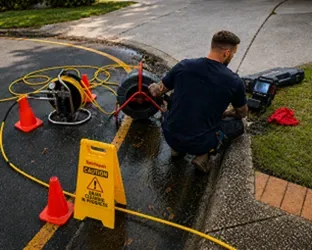
The recording is yours whatever it shows, and for an owners corporation it is the thing that makes a decision possible at a meeting.
Ask for the file rather than a viewing, and keep it with the building's records.